

Software for leasing companies: why standalone systems are no longer enough
- 25 May 2026
- In this article, you will learn:
- Sales as the first stage of the digital leasing process
- Lease management software as the operational center of the organization
- Insurance as part of the full lease administration cycle
- Receivables monitoring and debt collection in a process-based model
- GPS monitoring, control of dinanced assets, and key features
- The problem is not a lack of tools, but a lack of integration between them
- Automation as a way to scale the business
- A coherent lease management platform as a competitive advantage
- Summary: how can a leasing system improve your company?
- FAQ
- Let's have a chat!
In this article, you will learn:
- why single, separate systems are no longer enough for leasing companies to efficiently manage sales, contracts, insurance, receivables and financed assets;
- what role sales, leasing, insurance, debt collection and monitoring modules play in the daily operations of a leasing organization;
- how automation of leasing processes reduces manual data entry, lowers the risk of errors and speeds up customer service;
- why integrating a leasing system with insurance, finance, debt collection and GPS monitoring increases control over risk and financed assets;
- how a consistent system environment can become a competitive advantage for a leasing company and help it scale operations without increasing operational chaos.
The leasing market has been developing for several years under growing operational pressure. Customers expect fast decisions, a simple leasing process, transparent communication, and efficient service after signing lease agreements. At the same time, leasing companies are dealing with more data, documents, formal requirements, risk processes, debt collection activities, and responsibilities related to asset servicing.
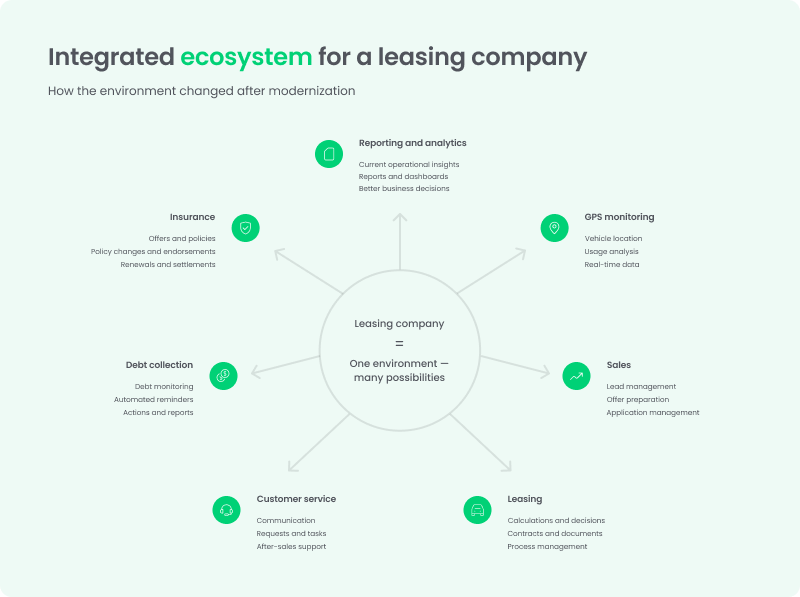
In this environment, sales effectiveness alone is no longer enough. A leasing company must operate like a well-connected organism in which sales, the leasing process, insurance, receivables monitoring, debt collection, and vehicle control function within one structured work model.
Today, the greatest advantage belongs to organizations that not only implement additional tools but are also able to connect them into one coherent operational environment. This is exactly where system integration helps reduce errors, shorten service time, improve risk control, and build a better customer experience. The modular structure of leasing software and lease management software makes it possible to flexibly adjust functions to the needs of leasing companies, which improves operational efficiency.
Sales as the first stage of the digital leasing process
The first contact between a customer and a leasing company very often determines how the rest of the cooperation will develop. If preparing an offer takes too long, data is collected manually, and the case status is unclear, the customer quickly starts comparing the service with competitors. That is why a sales support module has strategic importance for the entire organization.
A modern sales system should support lead handling, offer preparation, comparison of financing options, application management, and the transfer of cases to the next stages of the leasing process. It is also important that the salesperson has quick access to information about the customer, the financed asset, current conditions, and the case status.
In practice, a well-designed sales module organizes the beginning of the entire lease management process. It limits the need to work with spreadsheets, notes, and email correspondence. It makes data updates easier, reduces the risk of mistakes, and allows the team to move faster from a conversation with the customer to a specific offer.
From a business perspective, this means a shorter response time, greater predictability of the sales team’s work, and higher service quality. Salespeople can focus on the customer relationship and matching the offer instead of wasting time on manual data entry and collecting information from many sources.
Lease management software as the operational center of the organization
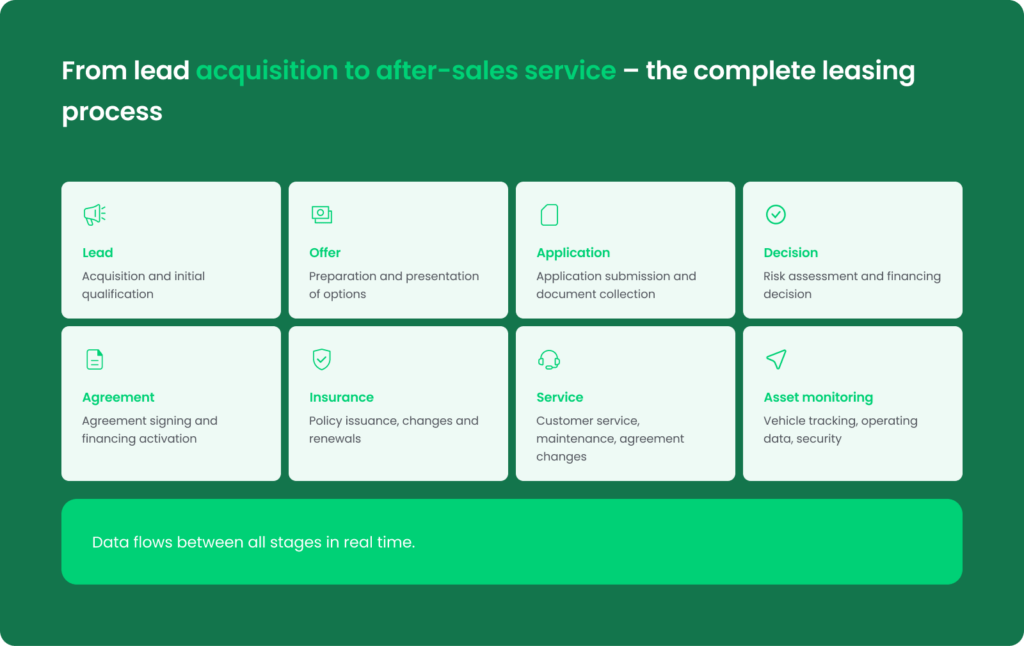
After the sales stage is completed, the case moves to the area that can be described as the operational center of the leasing company. This is where financing calculations, transaction parameter analysis, decision handling, preparation of lease documents, launch of the lease agreement, and coordination of activities related to handing over the leased asset take place.
A lease management software module should not be seen only as a database of lease agreements. Its role is much broader. It is a tool that supports process standardization, risk control, document circulation, task management, and communication between sales, analysis, operations, and customer service.
In a modern organization, clear case statuses, automatic rules, electronic document circulation, and the ability to monitor progress at every stage are essential. Thanks to this, the company can make decisions faster, manage documentation more efficiently, and reduce the number of manual activities.
A well-implemented lease management system improves not only internal efficiency but also the customer experience. The customer receives feedback faster, goes through formalities faster, and has a greater sense of control over the process. At the same time, management receives better insight into team workload, case flow, and potential bottlenecks.
Insurance as part of the full lease administration cycle
Insurance in leasing is sometimes treated as an addition to the main financing service. In practice, however, it is an important part of the entire process and has a major impact on customer service quality and the security of the organization.
The insurance module should support offer preparation, active policy handling, changes during the lease agreement, annexes, renewals, settlements, and deadline control. It is especially important that data concerning the customer, vehicle, agreement, and policy is consistent and available in one environment.
A lack of integration in this area often leads to duplicated work. The same information is entered several times, documents move between departments, and the risk of error increases with every data change. An integrated insurance module helps avoid this.
For the leasing company, this means greater control over post-sale processes. For the customer, it means more organized service and a lower risk of misunderstandings when the scope of coverage changes, renewals are handled, or documents are updated. Insurance then becomes a natural part of the lease administration process rather than a separate area disconnected from the rest of the organization.
Receivables monitoring and debt collection in a process-based model
Debt collection in a leasing company should not be associated only with actions taken when serious arrears occur. In a modern operational model, it is part of a broader process of managing receivables and risk.
A debt collection system should support ongoing payment monitoring, identification of delays, generation of reminders, action planning, task assignment to employees, documentation of customer contact, and handling of the next stages of the procedure. Repeatability and real-time process transparency are crucial here.
Thanks to this, the organization can react faster to the first signs of problems. Instead of acting only when arrears become serious, the company can take appropriate action earlier, based on current data. An efficient debt collection module supports financial liquidity, organizes team work, and helps make informed decisions based on facts.
However, the condition for effectiveness is integration with the lease management system and financial or accounting systems. Only then do employees have a full view of the customer’s situation, payment history, lease agreement status, and previous actions.
Without such integration, the debt collection process becomes slower and more prone to errors. Data has to be verified manually, information is scattered, and decisions are made based on an incomplete picture of the situation.
GPS monitoring, control of dinanced assets, and key features
In vehicle leasing, access to data about the assets themselves is also becoming increasingly important. Vehicle tracking systems are no longer only tools that support fleet security. More and more often, they are becoming part of a broader ecosystem for risk management, service, and management of financed assets.
Vehicle monitoring can support ongoing location control, analysis of usage patterns, management of operating information, and safety-related activities. In specific situations, this data can be useful for customer service, debt collection, risk, service, or fleet management departments.
For the leasing company, this means greater visibility of the assets being financed. For the customer, it may mean a higher level of security, a faster response in case of problems, and better organization of vehicle service. In the case of fleets, monitoring can additionally support service planning, cost control, and optimization of vehicle use.
However, the greatest value appears when data from GPS systems does not operate separately from the rest of the processes. If it is integrated with lease management software, a debt collection system, or a service system, it can genuinely support operational decisions and improve management quality.
The problem is not a lack of tools, but a lack of integration between them
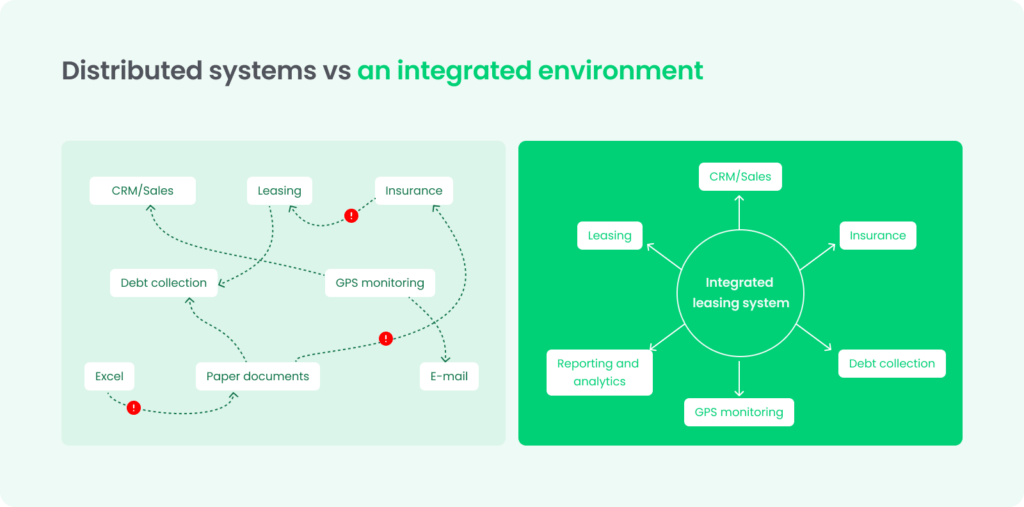
Many leasing companies use several or even a dozen different systems. One tool handles sales, another handles lease agreements, another supports insurance, and others are used for debt collection, reporting, or vehicle monitoring. At first glance, it may seem that the organization is well equipped technologically.
The problem appears when systems do not exchange data in an organized way. Employees have to re-enter information, manually update statuses, compare data from different sources, and search for documents in many places. This generates costs, extends service time, and increases the risk of mistakes.
A scattered environment also makes management more difficult. There is no single customer view, no single case history, and no single picture of the process. Managers have limited ability to quickly identify problems, while employees lose time on administrative activities that could be automated.
That is why integration is becoming a key direction for the development of leasing companies. It is not only about implementing another system, but about creating an architecture in which data flows between business areas without unnecessary barriers.

Automation as a way to scale the business
Automation in leasing is not only about replacing human work. Its main purpose is to organize the process, limit repetitive activities, accelerate the flow of information, and reduce the number of operational errors.
In sales, automation helps prepare offers faster and handle leads more efficiently. In the leasing process, it supports calculations, decisions, tasks, and documents. In insurance, it makes it easier to control deadlines, renewals, and data updates. In debt collection, it enables faster responses to delays. In vehicle monitoring, it provides current information about assets.
The shared result is greater predictability in how the organization operates. Processes are less dependent on manual work, easier to monitor, and more resistant to errors. The company can grow without a proportional increase in operational complexity.
Integration with systems also provides a better basis for data analysis and full control. If information is collected in an organized way, the company can report more effectively, plan actions, control risk, and develop its offer.
A coherent lease management platform as a competitive advantage
A modern leasing company today needs not only efficient tools but, above all, a coherent work model. Sales, leasing, insurance, debt collection, and vehicle monitoring should be elements of one process, not separate organizational islands.
An integrated lease management platform allows the company to serve customers faster, manage data better, reduce errors, and control risk more effectively. It also supports cooperation between departments, onboarding of new employees, and accurate financial reporting for management purposes.
In practice, the advantage belongs not to the companies that have the largest number of systems, but to those that can connect the most important areas of activity into one efficient workflow. This type of architecture makes it possible to build an organization that is more effective, scalable, and ready for further development of the leasing market.


Summary: how can a leasing system improve your company?
Leasing is becoming an increasingly complex process that requires efficient management of information, documents, risk, customer service, and assets. That is why leasing companies increasingly need integrated software solutions that cover not only sales and lease agreement handling but also insurance, receivables, debt collection, and vehicle monitoring.
Process automation in leasing systems helps eliminate manual activities, which increases operational efficiency and lowers costs. These are innovative solutions on the leasing company market.
Connecting these areas in one environment reduces operational chaos and increases efficiency. It also provides better insight into the entire lifecycle of a lease agreement — from the first contact with the customer, through financing and service, to post-sale activities and risk control.
Operating leasing has become the foundation of everyday functioning for many companies. That is why the future of the leasing industry will be increasingly connected with integration, automation, and conscious data management. These are the factors that will decide which organizations can handle the growing scale of business and rising customer expectations.
FAQ
A single system often supports only one part of a leasing company’s operations, such as sales, contracts, insurance, debt collection or vehicle monitoring. The problem appears when these areas are not connected. Employees have to manually re-enter data, check information in several places and update case statuses on their own. This extends customer service time, increases the risk of errors and makes the entire process harder to manage. That is why leasing companies increasingly need an integrated environment that connects key processes into one structured workflow.
Modern software for leasing companies should support the entire customer and contract lifecycle. The key modules include a sales system for managing leads, offers and applications; a leasing module for financing calculations, documents and contract management; an insurance module for handling policies, renewals and annexes; a receivables monitoring and debt collection system; and tools for controlling financed assets, such as vehicles. However, the greatest value comes not from the number of modules alone, but from their integration, which allows data to flow between departments without the need for manual work.
An integrated leasing system improves customer service because it enables a faster transition from the first contact to preparing an offer, issuing a decision, handling documents and activating the contract. Employees have access to up-to-date customer data, case status, financing terms, documents, policies and activity history in one environment. As a result, the customer receives feedback faster, and the company can respond more efficiently to their needs. This model reduces communication chaos, lowers the number of mistakes and creates a better customer experience throughout the leasing process.
Automation of leasing processes reduces errors and costs by limiting the number of repetitive tasks performed manually. The system can support offer preparation, calculations, document circulation, reminders, status updates, policy deadline control, handling payment delays and reporting. As a result, employees do not have to repeatedly re-enter the same data or manually monitor every stage of the process. The company gains greater operational predictability, better control over team workflows and the ability to scale its business without proportionally increasing operational workload.
A leasing system supports receivables management and debt collection when it is connected with financial data, customer history and contract status. This allows the company to identify payment delays faster, generate reminders, plan actions, assign tasks to employees and document contact with the customer. Debt collection does not have to begin only when arrears become serious. It can become part of a structured risk management process in which the organization reacts earlier, based on current data. This helps protect financial liquidity and increases the transparency of actions.
GPS monitoring helps leasing companies increase visibility over financed assets, especially vehicles. Data on location, usage and operation can support customer service, risk, debt collection, service and fleet management teams. In practice, vehicle monitoring makes it easier to control the asset that is the subject of financing, while also improving security and speeding up response in problematic situations. The greatest value appears when GPS data is integrated with the leasing, debt collection or customer service system and actively supports operational decisions.

As Head of Sales at Core Logic, Krzysztof is responsible for driving the sales development of technology and IT solutions for the e-Mobility, automotive, leasing, and insurance sectors. He focuses on building strong client relationships, identifying business needs, and translating them into concrete cooperation models and sales objectives. He has experience in web and mobile services, as well as technological support for the financing, leasing, and mobility sectors. Krzysztof combines a business-oriented perspective with a strong understanding of technology, supporting companies’ sustainable growth and implementations tailored to the real needs of the market.
Let's have a chat!
Are you ready to start your digital journey? Fill in this form or contact us directly by phone.