
SAS Viya implementation in practice: modernizing the analytics environment for UKNF
- August 20 2026
- In this article, you will learn:
- SAS Viya as an analytics, data management and AI platform
- SAS Viya, data integration, SAS Cloud Analytic Services and the analytics lifecycle
- Moving to SAS Viya: the data migration process is more than a software upgrade
- The role of the SAS technology integrator
- Stage one: planning the SAS Viya modernization
- Stage two: infrastructure preparation
- Stage three: SAS Viya modernization, data migration and asset integration
- User acceptance testing and project organization
- Training workshops, users and analytics tools
- Maintenance, support services and further development of SAS Viya
- The main challenges of the SAS Viya implementation and data migration project
- Summary: SAS Viya implementation, data migration and analytics transformation
- FAQ
- Porozmawiajmy
In this article, you will learn:
- what analytics platform modernization from SAS 9 to SAS Viya involves,
- the role Kubernetes and SAS Cloud Analytic Services (CAS) play in the implementation,
- how a high-performance and secure infrastructure was prepared,
- how the migration process covers data, code, models and other analytics assets,
- what responsibilities are handled by the technology integrator and expert team,
- how acceptance testing, system sign-off and user preparation are organized.
Modernizing an analytics environment in a public-sector institution involves far more than installing new software. It is a multi-stage transformation process that includes preparing a high-performance and secure infrastructure, conducting data migration and testing, and preparing users to work with the new platform. In the project delivered for the Polish Financial Supervision Authority (UKNF), this SAS Viya implementation combines analytics platform modernization with a data migration project. The current SAS 9 computing environment, deployed on premises, is being replaced with the modern SAS Viya platform. This article presents the key stages, challenges and technological aspects of this modernization effort.
The Polish Financial Supervision Authority (UKNF) is a state legal entity responsible for financial market supervision in Poland, covering sectors including banking, insurance, pensions and capital markets. The KNF Board works to ensure the stability, security and transparency of the market and to protect the interests of its participants, particularly customers of financial institutions.
The project involves modernizing an analytics environment based on SAS technology and operating on premises, moving to the newer SAS Viya architecture, completing data migration, conducting acceptance testing, preparing and training users, and subsequently maintaining the system. Moving data and other assets is therefore part of a comprehensive platform implementation and transformation process rather than a one-off upgrade.
Delivering the project required an interdisciplinary team of experts, including DevOps engineers, data engineers, system architects, administrators and testers. Their collaboration made it possible to design the architecture, prepare and configure the infrastructure, conduct data migration, move data assets and other analytical resources, and perform tests confirming the stability, security and correct operation of the SAS Viya environment.
SAS Viya as an analytics, data management and AI platform
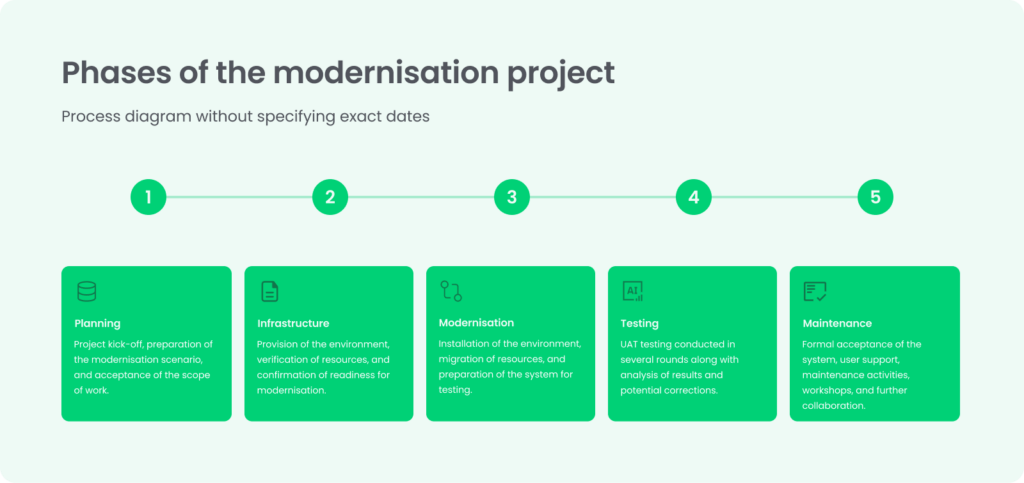
SAS Viya is an analytics, data management and AI platform developed by SAS. It supports the entire data and analytics lifecycle, from data preparation and data integration through exploration, reporting and modeling to model deployment and monitoring. It enables organizations to structure their analytical processes and work within a single, controlled environment. This strengthens data governance when data, reports, models and decisions are handled by multiple teams and users.
For institutions such as UKNF, the ability to process large volumes of data, monitor processes and prepare analyses supporting supervisory responsibilities is essential. SAS Viya is not a single reporting tool but a comprehensive environment for administrators, data analysts, technical teams and platform maintenance specialists. For this reason, its implementation also includes defining roles and processes, preparing documentation, conducting tests and organizing training workshops.
SAS Viya provides intuitive no-code and low-code visual interfaces that are user friendly and allow business users to work with data independently, reducing the workload of IT departments. These tools make analytical capabilities more accessible while maintaining control over business processes, data and analytical results.
SAS Viya, data integration, SAS Cloud Analytic Services and the analytics lifecycle
SAS Cloud Analytic Services plays an important role in the SAS Viya architecture. It is the component responsible for high-performance data processing. The platform combines the tools required for analytical work, including data preparation, management, modeling, monitoring and reporting. These platform tools enable an organization to structure its processes, reduce tool fragmentation and improve operational efficiency. In the financial sector, this approach supports data governance, security, operational consistency and regulatory compliance.
Another important capability is the integration of SAS Viya with different programming languages and data integration tools. SAS Viya supports languages including Python and R, enabling organizations to use external engines, libraries and open-source technologies within a single analytical ecosystem.
Moving to SAS Viya: the data migration process is more than a software upgrade
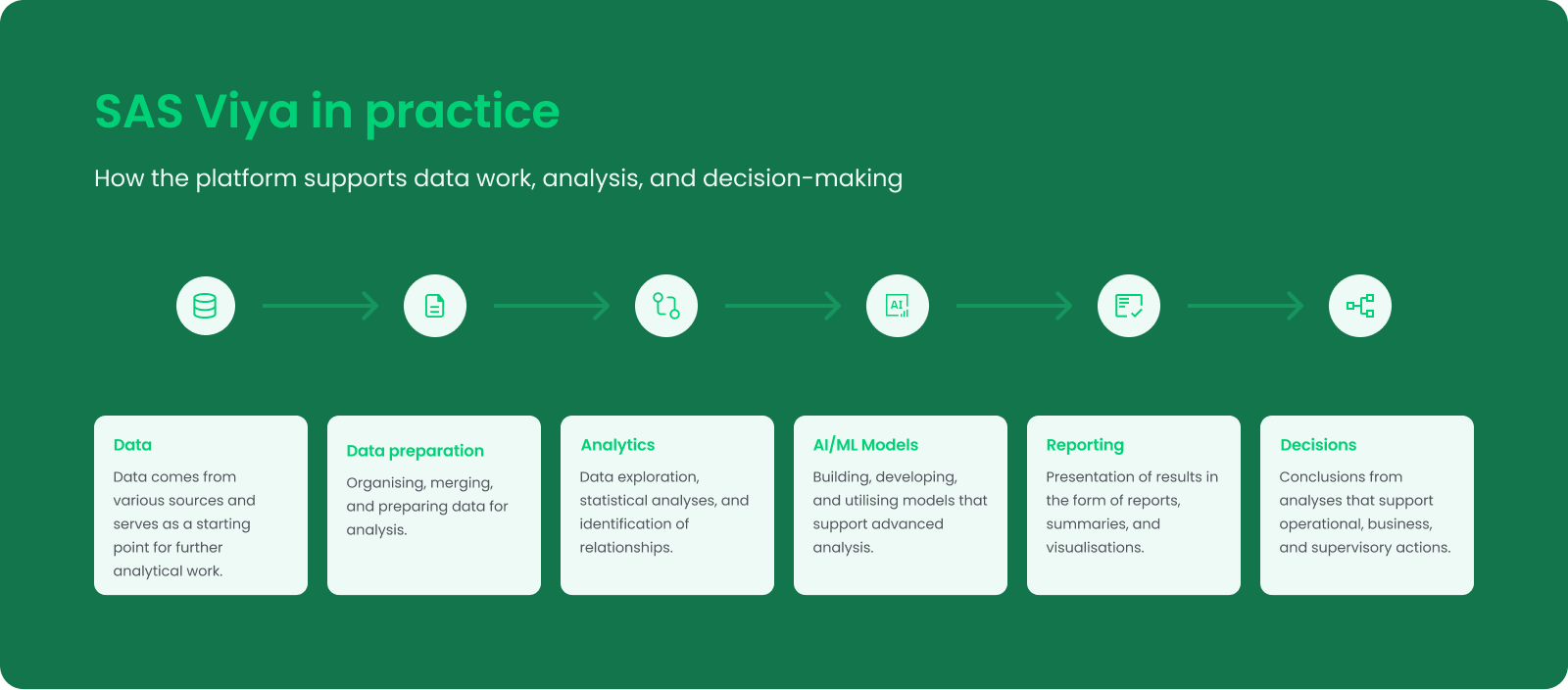
The modernization effort is not a routine software update. It combines analytics platform modernization with a data migration process involving a planning phase, infrastructure preparation, installation of the new environment and migration of selected assets. Moving to SAS Viya changes the operating architecture, platform management model and approach to maintaining the environment.
The data migration process for the new SAS Viya environment involves backing up existing data assets and restoring them in the new software environment. This approach is known as Backup and Restore. During data migration from an earlier platform such as SAS 9, SAS code can be moved to Viya using the SAS 4GL programming language. SAS Viya also supports integration with Python and R, enabling the use of external engines and open-source technologies. This migration process allows an organization to retain part of its existing analytical estate and gradually adapt it to the platform’s new architecture.
In environments of this kind, analytical capabilities are not the only priority. Security, transparency, regulatory requirements, compliance and control over the entire data and model lifecycle are equally important.
The role of the SAS technology integrator
The project team acts as the technology integrator for the SAS solution. This means connecting the client’s business requirements, contractual provisions, project schedule and infrastructure with the technology supplied by SAS and coordinating the relevant stakeholders.
The scope of work includes implementation coordination, cooperation with SAS, day-to-day communication with UKNF, preparation and management of the project schedule, participation in infrastructure verification, support for the modernization and data migration processes, preparation for acceptance testing, and subsequent system maintenance.
In practice, the integrator’s role extends far beyond installing software. It involves translating project requirements into an operational computing environment that meets technical, formal and business requirements. The integrator must understand the SAS platform, the client’s needs, the organization’s requirements, infrastructure constraints and best practices for managing implementation projects.
Stage one: planning the SAS Viya modernization
Implementing SAS Viya in the public sector requires particular precision. During the planning phase, the scope of work is defined by the contract, and each stage must be completed according to the agreed schedule and formally confirmed. In projects of this kind, not only technical activities but also document names, acceptance protocols, test scenarios, confirmations, deadlines and the method of calculating business days are important.
The project was therefore divided into clearly defined phases from the outset. On the delivery side, it was essential to combine technological, formal and organizational perspectives. On the client side, key activities included reviews, verification, testing and confirmation of readiness to proceed to each subsequent stage.
Stage two: infrastructure preparation
The next step was to prepare the infrastructure environment. SAS Viya requires a properly designed architecture based on Kubernetes, microservices and containers. This approach makes it possible to scale resources, manage platform components and deploy the analytical environment flexibly.
The project required servers to be made available and the current environment’s readiness for modernization to be verified. The infrastructure itself was provided by the client on premises, while the implementation team and SAS were responsible for confirming that the environment met the requirements necessary to begin the work.
This stage included verifying the delivered environment and hardware platform and confirming their readiness for the actual modernization activities. Working with a modern container environment was another important technological element. SAS Viya can be deployed in Kubernetes-based environments, including configurations that use Red Hat OpenShift. More generally, the software can run on a suitable cloud platform or on premises; this project uses the latter model.
Stage three: SAS Viya modernization, data migration and asset integration
Once the infrastructure had been confirmed as ready, the main modernization and data migration work began. This was a critical point in the project. The work had to follow the agreed plan while meeting technical, formal and regulatory requirements. The objective was to prepare an environment that could subsequently be submitted to UKNF for acceptance testing.
This phase of the data migration project included moving data, existing analytical projects and other assets. From a project perspective, data migration was an integral part of the modernization and a prerequisite for moving to the next stage.
Acceptance test scenarios were developed in parallel with data migration. They covered functional testing, performance testing and compliance with security requirements. The scenarios were provided to the client before the system was formally declared ready for acceptance testing. Defining the scope of verification in advance improved preparation for the testing process, enabled earlier analysis, reduced the risk of problems emerging during final acceptance and limited overall project risk.
User acceptance testing and project organization
After the modernization and data migration work was completed, the system was declared ready for User Acceptance Testing (UAT). The UAT phase allowed the client’s users to verify the environment, submit comments and confirm that the platform’s key areas and access controls operated correctly. This testing reduced technical and migration risk during the final stage of the project and prepared the production environment for formal sign-off.
Due to the nature of the contract, the project had clearly defined stages, deadlines and acceptance procedures. At the same time, elements of an agile approach were used in day-to-day work to facilitate ongoing coordination. Regular meetings and project summaries made it possible to monitor progress, discuss risks and issues, and plan the next activities.
Training workshops, users and analytics tools
Modernizing an analytics environment also requires users to be prepared to work with SAS Viya software. Workshops are tailored to different user groups. System administrators need the knowledge required to use monitoring and administration tools, respond to technical issues and support the environment’s day-to-day operation. Data analysts, in turn, need to understand how to use the platform’s tools so that they can perform their analytical tasks effectively. The scope of the workshops must reflect both the client’s requirements and SAS training standards.
Maintenance, support services and further development of SAS Viya
Once modernization, data migration and acceptance testing have been completed, the project moves into maintenance mode. This includes user support, ticket handling, administrative activities, licensing matters and assistance in resolving issues related to the platform’s day-to-day operations.
The first year of the project is particularly important because it includes extending the license for the existing environment, purchasing SAS Viya licenses, modernizing the system, conducting data migration, performing tests and preparing users. In subsequent years, the main focus shifts to maintenance, support services and ensuring continuity of operations.
Developing the team’s expertise is also an important part of this stage. Working with SAS Viya requires knowledge of the platform itself, its technical environment, administrative processes and the way end users work. System maintenance therefore involves not only responding to tickets but also gradually deepening the team’s knowledge of the environment and the analytics projects operating on the client side, enabling the team to support users more effectively.
The main challenges of the SAS Viya implementation and data migration project
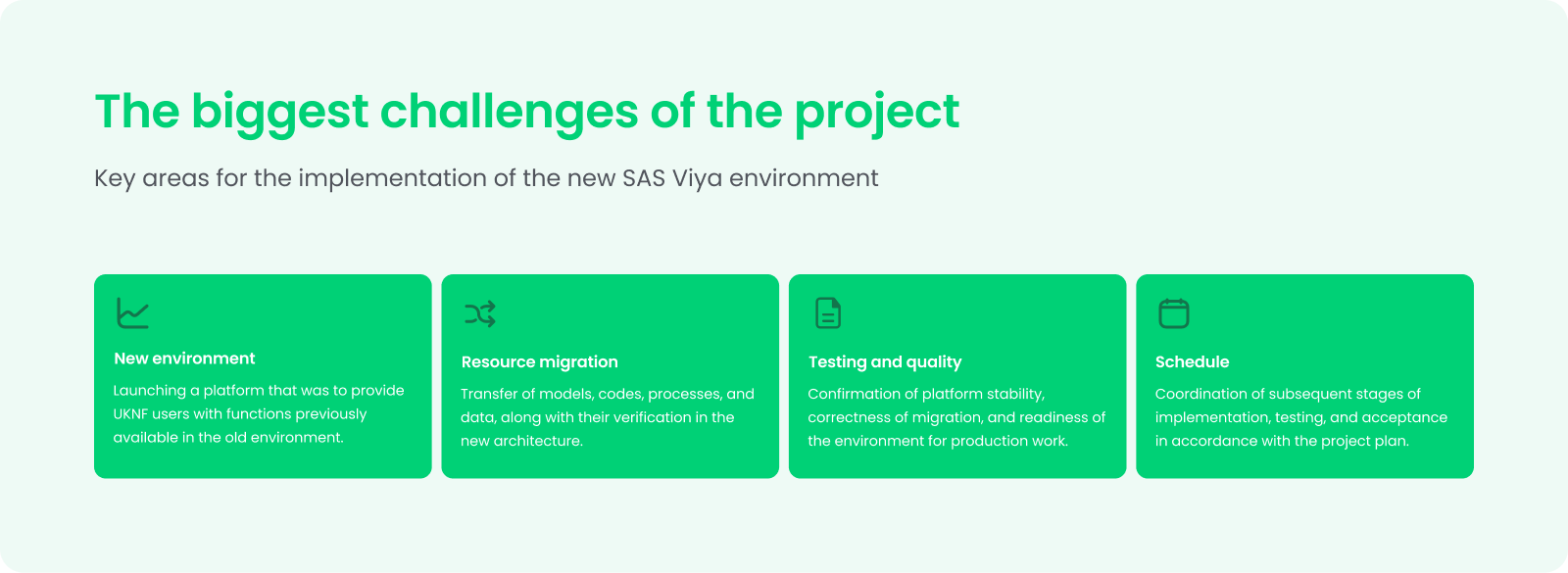
The main project challenges included launching a new analytical environment capable of providing the functions previously used by UKNF users. This involved not only deploying the SAS Viya software but also preparing the infrastructure and configuring services, permissions, access controls and data access.
Another key challenge was the SAS 9 to SAS Viya migration. The traditional SAS 9 architecture limited the ability to scale and process growing data volumes efficiently. Moving to SAS Viya made it possible to use the distributed in-memory processing capabilities of SAS Cloud Analytic Services (CAS), Kubernetes-based containerization and a more modern user interface. The modernization required not only deploying SAS Viya but also moving data and other assets, adapting processes and confirming their correct operation within the new architecture.
Data migration involving analytical assets, including models, code, processes and data, was another essential component. Each area had to be verified for compatibility with the new architecture and correct operation in SAS Viya. Testing and quality control were equally important. They confirmed platform stability, data migration accuracy and the environment’s readiness for production use. All work also had to follow a schedule that structured the successive implementation, testing and acceptance stages.
Summary: SAS Viya implementation, data migration and analytics transformation
The modernization of UKNF’s analytical environment is a complex technological and organizational data migration project designed to move the organization to the modern SAS Viya platform and prepare the environment for future analytical work.
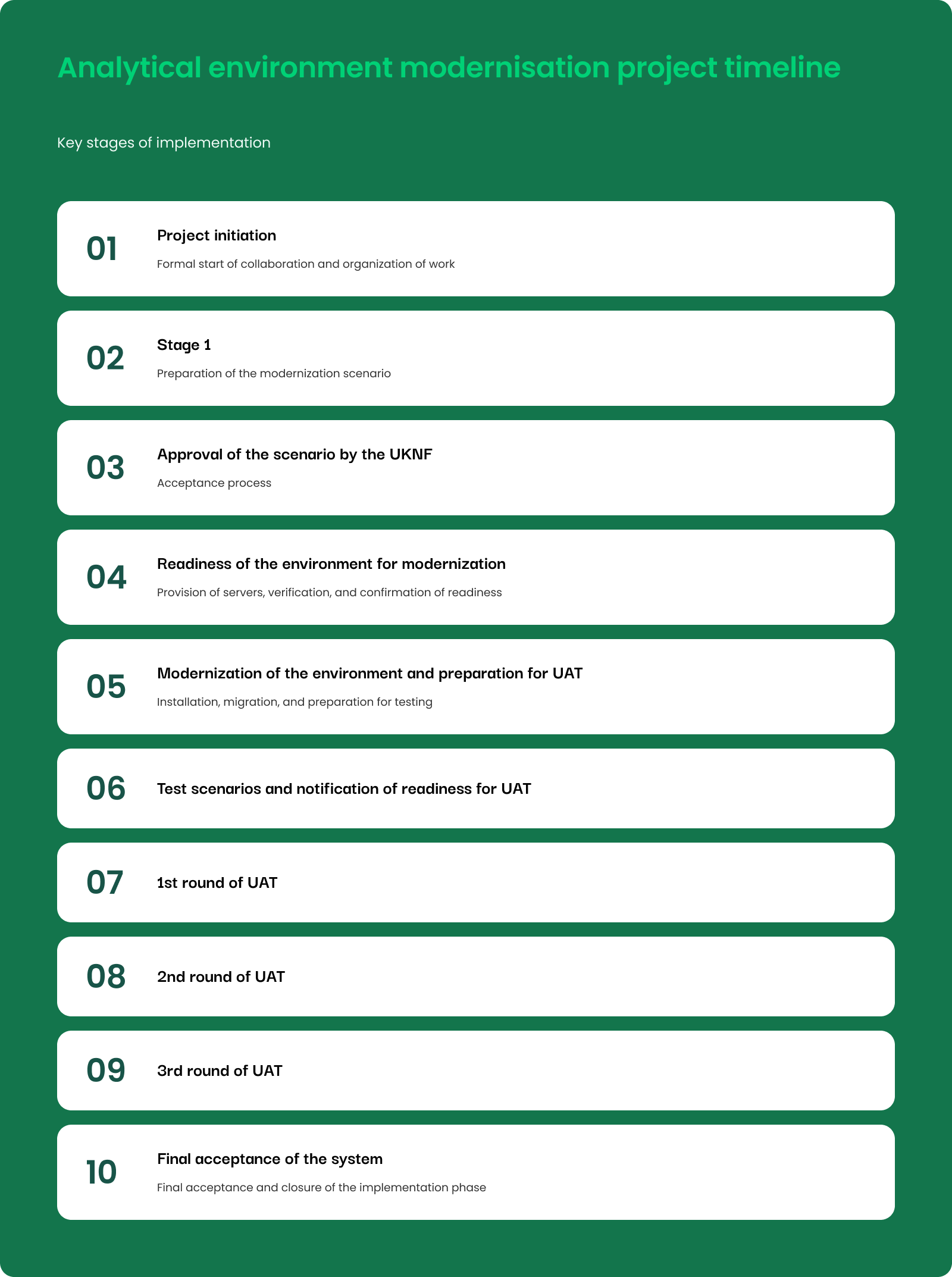
The project includes several stages: developing and approving the modernization plan, verifying the infrastructure, installing the software, completing the data migration process, conducting acceptance testing, obtaining final sign-off and transitioning to maintenance. Each phase requires precise coordination and compliance with formal and business requirements.
The SAS Viya implementation demonstrates that modern analytics in a public-sector institution does not begin with an algorithm alone. It starts with a well-planned process, stable and high-performance infrastructure, a clear division of responsibilities and consistent delivery of the data migration and implementation stages. Only this approach can create an environment that genuinely supports day-to-day analytical work, data management, process monitoring, reporting and data-driven decision-making.
FAQ
SAS Viya is a modern analytics platform that offers greater scalability, flexibility and data-processing performance than SAS 9. It uses a microservices architecture, Kubernetes-based containerization and the distributed in-memory processing capabilities of SAS Cloud Analytic Services (CAS). The platform also supports integration with Python and R and provides modern no-code and low-code interfaces.
The data migration process from SAS 9 to SAS Viya includes assessing the current environment, preparing the infrastructure, installing the new platform software, and moving data, code, models and analytical processes. Selected data assets can be transferred using a Backup and Restore approach. After data migration, each element should be verified for compatibility with the new architecture and correct operation in the SAS Viya environment.
SAS Viya requires a properly designed container infrastructure based on Kubernetes. The environment should provide sufficient compute capacity, memory, storage, network connectivity and the ability to scale resources. Monitoring, backup, access management and high-availability mechanisms are also important. The deployment can be cloud based, using a suitable cloud platform, or the software can run on premises.
SAS Viya security covers access controls for data and resources, role and permission management, authentication mechanisms, secure communications and platform monitoring. In public-sector institutions such as UKNF, data governance, security and regulatory requirements are considered from the architecture design stage and are subsequently verified through acceptance testing and formal validation procedures.
SAS Viya acceptance testing verifies implemented functionality, system performance, environment stability, security and data migration accuracy. Tests are conducted using previously prepared scenarios. Once the platform has been declared ready, the client performs User Acceptance Testing, submits any comments and confirms that the requirements have been met. Successful testing enables formal acceptance of the production environment and transition to the maintenance stage.

As Vice President of Core Logic, Konrad is responsible for developing technology solutions that support the business growth of clients. He has over 20 years of experience in the IT industry, including leading ambitious projects focused on building, scaling, and securing IT infrastructure. He specializes in DevOps, microservices, and cloud solutions. Konrad combines a technological perspective with a business-oriented approach, enabling him to translate complex organizational needs into stable, secure, and efficient systems.
Porozmawiajmy
Jesteś gotowy, aby razem rozpocząć Twoją cyfrową podróż? Wypełnij nasz formularz lub skontaktuj się z nami telefonicznie.