
Modern PostgreSQL cluster architecture – Patroni, PG Bouncer and ETCD in practice
- 6 March 2025
In this article, you will learn:
- what a modern PostgreSQL cluster architecture is and how it supports high availability, data security and application reliability;
- what role Patroni, ETCD, PG Bouncer and PG Backrest play in the cluster, and how these tools work together;
- how automatic failover works and why it reduces the risk of downtime in the event of a primary database server failure;
- what benefits and challenges are associated with implementing a PostgreSQL cluster based on Patroni, including automated failover, data protection and the need for regular monitoring.
Core Logic implements projects using advanced technologies such as Patroni, PG Bouncer, ETCD and PG Backrest, ensuring high availability, reliability and data security in PostgreSQL-based database environments. The solution provides high availability, data security and application performance reliability, minimizing the risk of downtime in case of server failures. The article will outline the main technical principles, challenges and benefits of using this architecture in a wide range of ongoing projects.
Key elements of the PostgreSQL cluster architecture
In the projects implemented by Core Logic, we use the PostgreSQL cluster architecture with several important elements, such as:
Patrons – a PostgreSQL cluster management tool that is responsible for ensuring high database availability and automatic failover between servers.
ETCD – a distributed configuration management and coordination tool that monitors the status of servers in a cluster and decides which server acts as the leader (primary).
PG Bouncer – a lightweight proxy for managing connections to the PostgreSQL database, which distributes traffic among the database servers, directing SQL queries to the current leader.
PG Backrest – a backup tool that further protects data by storing it on an external server.
How does a PostgreSQL cluster with Patroni and ETCD work?
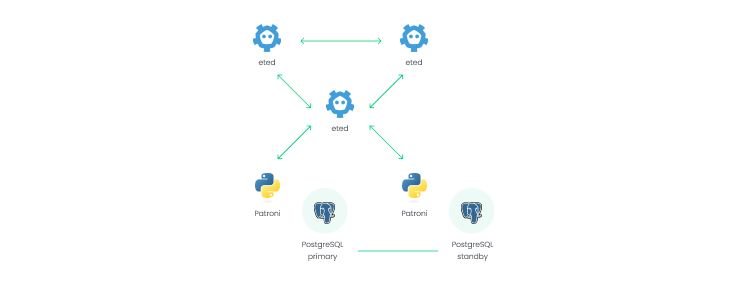
PostgreSQL cluster architecture can be implemented in an environment where there are a minimum of two (or more) database servers, one of which acts as the leader (primary) and the others are standby. Servers occurring in the cluster are continuously replicated servers, ensuring real-time data synchronization. In the event of a failure of the leader server, an automatic switchover (failover) takes place in a short time, and the role of the leader is transferred to another standby server.
The central element that coordinates the operation of the entire system is ETCD. This is a service that monitors the status of each server in the cluster, sending information regularly about their current state. In the event of a failure of the main server, ETCD automatically selects a backup server from among those available, so that there is no interruption in the operation of the application.
PG Bouncer, in turn, acts as a “letter carrier” for SQL queries – directing them to the appropriate database server. When there is a failure and a change of server, PG Bouncer receives information about the change and automatically starts redirecting queries to the new server.
Advantages of implementing a Patroni cluster
The biggest advantage of this solution is security and reliability. Thanks to the Patroni-based architecture, the risk of data loss is almost completely eliminated. Even in the event of a server failure, the system automatically switches to the backup server, which ensures uninterrupted operation of applications without the need for administrator intervention. Manual switching of servers, as was the case with traditional solutions, is no longer necessary.
The second key benefit is the automated failover process. In a situation where one of the servers fails, there is no downtime – the system switches to the backup server by itself, and in the meantime administrators can work on restoring the failed server to normal operation.

Challenges during deployment
Although the documentation of tools such as Patroni, ETCD and PG Bouncer is very well done, the implementation process can encounter problems, such as developing a suitable tool to migrate existing databases to a new Patroni-based environment. In this case, you can create an Ansible playbook that automatically migrates databases to the cluster with Patroni.
Further development and optimization
Currently, the infrastructure used in Core Logic’s projects meets all performance and reliability assumptions, eliminating the need for immediate resource expansion. However, as the database continues to grow, it is necessary to regularly monitor its condition and consider possible future expansion of hardware resources to maintain optimal system performance and stability.
Summary
The implementation of a PostgreSQL cluster with Patroni, PG Bouncer and ETCD has brought numerous benefits, including automation of the failover process, increased data security and reliability of application performance. As a result, such projects can operate without interruption, and data is always available, regardless of possible server failures. This solution is an excellent example of how modern technologies can secure data and improve application performance.
FAQ
A PostgreSQL cluster with Patroni, PG Bouncer and ETCD is a database architecture designed for high availability, reliability and data security. Patroni is responsible for managing the PostgreSQL cluster and automatically switching between servers in the event of a failure. ETCD acts as a distributed coordination mechanism and monitors the status of individual servers. PG Bouncer manages database connections and routes queries to the current primary server. This combination of technologies helps reduce the risk of downtime and ensures stable operation of applications using PostgreSQL.
Patroni ensures high availability of PostgreSQL by automatically managing server roles within the cluster. One server acts as the leader, or primary database instance, while the others operate as standby servers. If the primary server fails, Patroni can switch the leader role to one of the standby servers. As a result, applications can continue using the database without the need for manual administrator intervention. Automation of the failover process reduces the risk of long downtime and increases the resilience of the entire database environment.
ETCD plays the role of a distributed coordination system in a PostgreSQL cluster and stores information about the state of the environment. It monitors which servers are available, which one currently acts as the leader and when a switch to a standby server is required. In the event of a primary server failure, ETCD supports the selection of a new leader from the available instances. This allows the cluster to operate in an orderly and predictable way. ETCD is therefore one of the key elements of a high-availability architecture, as it helps maintain consistency in the decisions made across the cluster.
PG Bouncer is used to manage connections between applications and the PostgreSQL database. In a cluster architecture, it acts as a lightweight proxy server that routes SQL queries to the correct database instance, namely the current leader. When a failure occurs in the cluster and the primary server changes, PG Bouncer can redirect traffic to the new leader. As a result, the application does not need to directly manage all connection details with the database. PG Bouncer improves stability, organizes connection handling and supports system continuity on the application side.
Automatic failover in a PostgreSQL cluster involves quickly switching the role of the primary server to a standby server in the event of a failure. Under normal conditions, one server operates as the primary instance, while the others act as standby instances. Data is replicated between servers so that standby instances can take over if problems occur. When the cluster detects a leader failure, coordination mechanisms select a new primary server, and application traffic is redirected to the working instance. This allows the system to maintain continuity and limit the impact of the failure on end users.
Implementing a PostgreSQL cluster based on Patroni increases the availability, reliability and security of the database environment. The main benefit is automatic failover, which allows the system to switch to a standby server if the primary instance fails. This solution reduces the need for manual administrator intervention, lowers the risk of downtime and improves application continuity. In addition, an architecture using PG Bouncer, ETCD and PG Backrest supports better connection management, cluster coordination and backup creation. It is a good solution for projects in which database stability is critical.

As Vice President of Core Logic, Konrad is responsible for developing technology solutions that support the business growth of clients. He has over 20 years of experience in the IT industry, including leading ambitious projects focused on building, scaling, and securing IT infrastructure. He specializes in DevOps, microservices, and cloud solutions. Konrad combines a technological perspective with a business-oriented approach, enabling him to translate complex organizational needs into stable, secure, and efficient systems.
Let's have a chat!
Are you ready to start your digital journey? Fill in this form or contact us directly by phone.