
SellTool Lite
SellTool Lite
Company
Representatives of Vehis, a leader in the leasing industry, decided to create SellTool Lite, a mobile sales enablement app for sales reps that supports optimization of the sales process and the decision-making process. The goal was to provide sales reps, sales managers, and other members of sales teams with a simple solution enabling fast access to key information about customers, financing products, leasing products, and the current statuses of applications.
The application works on mobile devices, giving users easy access to statuses and tasks in real time, without the need to log in to the web application or check email. SellTool Lite was designed as part of the broader Vehis software ecosystem and as a starting point for further feature expansion in the future, in line with the needs of users and IT teams. In this sense, it functions as a practical mobile sales app, a lightweight sales app, and a focused tool for modern sales organizations that need quick access to information in the field.
Mobile sales enablement app
During the development of SellTool Lite, Core Logic focused on simplicity, fast implementation, and efficient use of resources. Due to cost and time constraints, the team decided to use a lightweight API provided by the SellTool system. As a result, the app uses the same data, but offers a limited range of operations.
This approach reduced the need to build complex logic on the mobile side and made it possible to focus on what the sales department needed most: fast checking of statuses, application lists, and tasks, as well as clear messages. SellTool Lite reduces dependence on email correspondence and the manual transfer of information, while maintaining consistency with the web platform and integrating easily with existing processes. This supports sales automation, selected elements of workflow automation, and smoother execution of everyday business processes for field sales teams, outside sales teams, and managers.
Because the application is intentionally simple, it does not try to replace all existing sales tools. Instead, it gives users a faster way to access the most important information needed in the daily sales workflow. This was a major advantage for teams that needed speed, clarity, and mobility rather than a heavy interface.
Project goals
Provide faster and simpler access to basic information such as application statuses and tasks for sales reps, sales managers, and other employees involved in sales.
Improve process handling through digitalization and the automation of notifications and communication.
Support a more efficient sales workflow and daily work of sales teams with a practical sales app available on mobile devices.
Mobile sales app
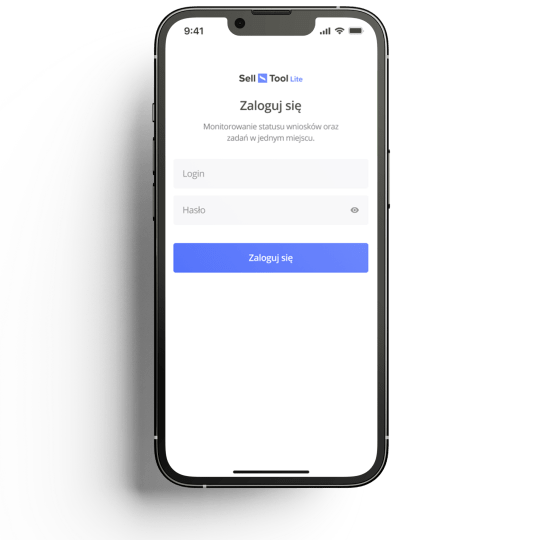
SellTool Lite is a mobile tool created with the convenience and efficiency of Vehis’s sales department in mind. Users log in with the same credentials as in the web system, which simplifies implementation and maintains compliance with security principles and formal requirements.
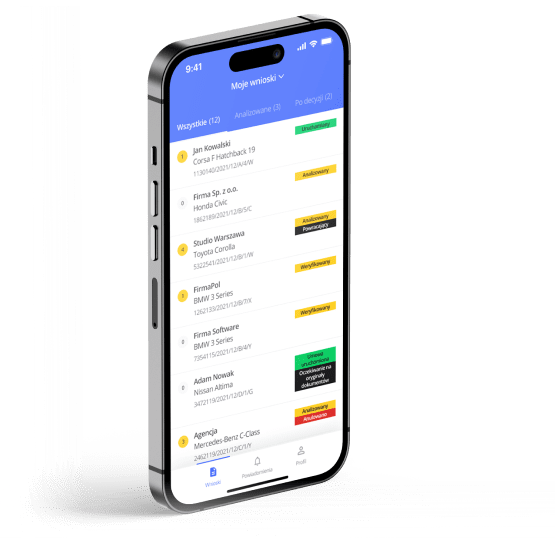
The applications for Android and iOS, with the possibility of running on compatible devices, make it possible to browse the list of applications, including those submitted for verification, and to follow progress and statuses in real time. As a result, sales reps have key information in one place: customer details, application number, financing product, vehicle make and model, as well as the number of assigned tasks and alerts, without the need to use a computer or additional equipment.
This makes SellTool Lite a practical mobile sales app and sales app for field sales reps, helping them work more efficiently throughout the sales cycle. It supports faster access to information, better responsiveness, and helps boost productivity in the daily work of mobile teams. For Vehis, this mobile-first approach improves how sales teams operate in the field and how they use essential sales content and status information.
Lead management software
The application provides up-to-date information on application statuses and makes it possible to adapt views to user roles. Sales managers have access to a team view that facilitates monitoring progress and identifying cases requiring action. Users can move to application details with one click, see the number of tasks, their content, and the history of status changes, which supports analysis and fast decision-making.
SellTool Lite also enables quick searching and filtering of applications by parameters such as application number, customer name, make, model, financing product, number of tasks, status, or case type. A summary view is also available, making it possible to monitor all applications and extract the most important information without moving through many screens. The application was designed to be intuitive, and its functions respond to the real needs of users, from sales representatives to managers, while leaving room for further development.
These key features support the daily work of sales teams, improve visibility across the sales pipeline, and strengthen task management for both individual users and managers. They also support better handling of customer data, better access to CRM data already available in the broader ecosystem, and more effective monitoring of the current sales funnel. Although the application is not a full mobile CRM, it supports selected needs commonly associated with customer relationship management, especially where teams need quick access to status information, customer context, and action history.
In practical terms, the application helps users follow cases, monitor assigned work, and stay informed without relying on a desktop environment. This improves lead tracking at the application level, supports more structured follow ups, and gives users better visibility into ongoing work. In this sense, the app contributes to simpler lead management and better handling of operational steps around financing cases.
Key features
A key element of the solution is automatic notifications and a push notification system. The application sends notifications in the event of new tasks, changes in application status, reminders about activities, and important messages, so sales reps do not need to constantly refresh lists. In selected scenarios, the solution may also support SMS messages or other communication channels, depending on integrations and company policy. This approach reduces delays in service handling and shortens response times, which translates into higher efficiency.
These notification mechanisms support automated follow ups, improve follow ups on pending cases, and make the sales process more dynamic. They also reduce the need for repetitive checking of information and help sales teams respond to changes at the right moment. Access to current updates and statuses provides users with practical real time insights into ongoing work and helps them manage their next steps more effectively.
For sales managers, such notifications support faster supervision of team activity. For field sales teams and field sales reps, they reduce reliance on manual communication and make the daily sales workflow more efficient. This is especially valuable in complex sales organizations, where even small delays in information flow can affect the broader sales cycle and the speed of closing deals.
Challenges
The challenge was not only technical implementation, but above all the optimization of time and resources. The decision to make the application largely read-only and to retrieve data from a lightweight API resulted from the intention to create the fastest and most economical solution possible while still meeting the needs of the sales department.
Although this meant limitations in adding and editing data, the strategy made it possible to maintain simplicity, stability, and high performance, while focusing on the key value: immediate access to information and real-time push notifications. This architecture also made it easier to plan future integrations and feature expansion without rebuilding the entire application.
This approach reduced unnecessary manual tasks, limited additional data entry, and helped teams focus on the most important stages of the sales process and sales cycle. It also created a solid base for future crm integration, additional workflow automation, and wider use in more complex internal environments. By limiting the scope of the first version, the team could concentrate on what mattered most to users and avoid overly complex technical setup at the initial stage.
A major advantage of this architecture was that it preserved consistency with the web platform while giving mobile users immediate access to the information they needed most. It also created room for future development toward a more advanced mobile CRM, more extensive sales automation, and deeper support for operational business tools used by Vehis.
Results
- Vehis’s sales department gained faster and more intuitive access to key information about application statuses and tasks, available on mobile devices in real time.
- Thanks to automatic notifications and push notifications, the application reduced the need to check email and the web platform, which shortened response time and improved work efficiency.
- SellTool Lite improved the management of applications and monitoring of progress, which resulted in higher user satisfaction and better support for the leasing and financing sales process.
- The application became a solid base for further feature development, new integrations, and future growth of the software ecosystem. In this sense, it provides a practical foundation for future crm integration, additional sales automation, and a more scalable solution for mobile users in the field.
- SellTool Lite serves as a focused mobile sales enablement app, a practical mobile sales app, and an efficient sales app for sales teams, sales reps, and sales managers.